

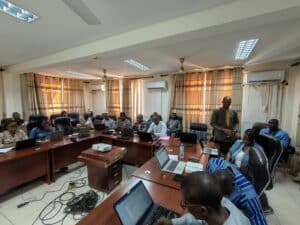
Results Presentation Workshop, July 23–24, 2026 · Ministry of Health / ST-RFS · with support from the Gates Foundation.
Background on Free Healthcare
On March 2, 2016, the Council of Ministers introduced five measures providing free services for women and children under the age of five: pediatric care, childbirth, cesarean sections, prenatal care, and screening for women’s cancers. The decision marked a decisive first step toward universal health coverage, and its effects were immediate: between 2016 and 2023, the use of curative care for young children tripled.
Ten years later, the picture is somewhat mixed. Free care has removed the cost barrier, but not all the others. Out-of-pocket payments still account for 34.9% of health care spending, geographic disparities persist, and reimbursement arrears are straining the cash flow of health care facilities. To strengthen the policy without undermining it, the Ministry and its partners have rolled out, year after year, seventeen optimization initiatives across three areas: governance and coordination, the efficiency of free healthcare, and communication and transparency.
RESADE evaluated nine of these initiatives independently and using a common framework (the WHO maturity matrix and the OECD-DAC criteria). One finding runs through them all: the foundations are solid, implementation is “progressing,” and the challenge is no longer to demonstrate the relevance of these reforms, but to ensure their sustainability.

Developing a Management Framework: Governance of Free Access
Any nationwide policy needs a forum for taking stock. For universal health coverage, this forum was established very early on through the review meetings. Nine such meetings have been held over the past ten years, bringing together stakeholders from the health and finance sectors, technical and financial partners, researchers, and civil society. The evaluation confirms their legitimacy: alignment with national policies is unanimously viewed as positive, and 96.4% of respondents recognize the relevance of the meetings. Above all, these meetings have played a role that no policy document explicitly assigned to them: that of an incubator. Other initiatives—such as individualized healthcare billing, patient-specific dispensing, the WISN method, and e-financial flows—have emerged from their recommendations. Their main weakness lies in the final link in the chain: follow-up on recommendations. At the top of the list of frustrations are the same issues as always: reimbursement arrears, which have been reported continuously since 2016.
Citizen oversight of the free-of-charge policy has also been equipped with a safeguard. Established in March 2021 by decree, upon the recommendation of the ASCE-LC, the NGO Report Validation Committee methodologically reviewed and validated the reports produced by the organizations tasked with verifying the effectiveness of the free-of-charge policy on the ground. It held regular quarterly sessions from 2022 to 2024 and produced high-quality, standardized tools (criteria, templates, user guides) that directly informed the design of FIScontrol. However, its founding decree limited it to formal validation, without any enforcement authority: the same irregularities recurred from one session to the next, only 40% of health centers were covered by the audit, and the elimination of per diems caused participation to plummet. Its operations were suspended in June 2024 in favor of digital tools: the FIS and FIScontrol.
The following initiative is the most recent in the “governance” framework and is also the most strategic. Established by the interministerial decree of July 11, 2023, and chaired by the Minister of Health, the Steering and Monitoring Committee for Free Healthcare (COS-GFS) comprises forty-five members, including fifteen technical and financial partners. In three productive sessions and less than two years of existence, it has adopted an expansion plan, examined the extension of the coverage package to nine conditions, and set the course: a gradual transition to the Universal Health Insurance System, with a target date of the fourth quarter of 2025. The committee must still establish mechanisms to monitor the implementation of its decisions and formalize its coordination with the review meetings: this coordination is essential for the successful transition to universal health insurance.

Making Free Services Efficient: Tools and Pricing
These six initiatives demonstrate the Ministry’s efforts to control costs and ensure data reliability.
The first addresses staff allocation. The WISN method, a WHO tool rolled out in 2018 with support from the Global Fund, measures the actual workload at health facilities to base staffing assignments on data rather than on tradition. There is strong agreement on its relevance (82.5% of respondents), but the evaluation reveals a 45-point paradox: perceived effectiveness does not exceed 37.5%. The tool objectively identifies shortages but lacks the means to address them. It shows that the midwife-to-population ratio has now been met (1.19, thanks to targeted recruitment), but that the shortage of nurses persists: the ratio is only 0.76, representing a shortfall of nearly 1,700 positions, and six regions (Sirba, Nakambé, Oubri, Kuilsé, Yaadga, and Gulmu) are facing a critical shortage. Furthermore, the deterioration of the database in 2024 indicates a decline in technical support.
The second initiative aims to shed light on the funding for free healthcare. The e-flux financial system, developed within the Digital Minimal Ecosystem, digitizes the accounting records of 2,012 health facilities spread across 70 districts and tracks the flow of funds between the central government, the districts, and the field. The assessment paints a grim picture: two systemic flaws are disrupting the financial cycle. Six out of ten health facilities have a negative free-of-charge balance—including all regional hospitals (CHRs) and university hospitals (CHUs)—and 2.80 billion in arrears have accumulated across 46 facilities in critical condition. The tool exists, but it remains blind to the amounts that matter most, and three of its six strategic use cases remain stalled.
The following two reforms are part of the same initiative. The harmonization of rates in July 2023, followed by the introduction of the individual bill for free care (FIS) in January 2024, were aimed at standardizing costs and ensuring the reliability of billing. The impact assessment, based on more than 242,000 observations and 30.3 million billed visits, accurately measures the effect: the total reimbursed cost fell by 40.6%, representing a sustainable savings of 11 to 12 billion CFA francs per year. However, nine-tenths of these savings stem from a drop in billed volumes, not from lower prices. The individual bill has filtered billing. And this decline is not uniform across regions: -5% in the Cascades and -54% in Tapoa, with distance from the university hospital, insecurity, and the density of healthcare facilities alone accounting for 81% of the differences. National collection rates remain healthy (98.8%), but they are plummeting in the Liptako region (-29% per year), threatening the system within twelve to eighteen months. Hence the evaluation’s key recommendation: create a Healthcare Access Equity Fund, financed by half of the savings achieved, to ensure that marginalized areas are not neglected.
The fifth initiative takes place at the patient’s bedside. The individualized, patient-specific dispensing system delivers medications dose by dose, directly to the bedside, in university hospitals and certain regional medical centers. The success is clear: 82.9% of patients received their medications at their bedside, and 79.3% believe the system reduces their healthcare costs. However, the evaluation describes a DIN that is “present but empty”: due to stock shortages, 85.4% of patients still had to purchase medications at private pharmacies during their stay, with 67.1% doing so multiple times, sometimes in the middle of the night. Behind these shortages lie four structural causes: the financial stranglehold on hospital pharmacies, whose revenues are remitted to the Treasury without being able to be reinvested; the rigidity of the public procurement system and dependence on CAMEG; the fear of criminal penalties among healthcare providers; and a shortage of infrastructure and staff. The assessment proposes setting aside a “vital basket” of medications, with priority given to pediatric drugs.
The latest initiative literally reaches out to local communities. The mobile clinics—a total of fifteen specialized units affiliated with regional hospital centers (CHRs) and university hospitals (CHUs)—bring healthcare to the most remote areas, particularly for the screening of women’s cancers. The results speak for themselves: 23,781 services provided, including 20,917 cervical screenings and 155 immediate treatments; a program effectiveness praised by 96% of staff; and a real impact on isolated communities, with 38.9% of beneficiaries coming from areas located more than ten kilometers from a permanent facility (a health center hosting the clinic). The evaluation identified several weaknesses: a nine-month delay in launching the program, budget overruns of 40%, highly uneven activity levels from one clinic to another, and 57% of health zones that were never visited. Four key bottlenecks were identified: maintenance, a shortage of specialists, the lack of a dedicated operating budget, and a lack of communication with training institutions. The challenge, the evaluation concludes, is no longer to convince others of the program’s relevance, but to ensure its sustainability.
A Cross-Functional Analysis: Strengths, Weaknesses, Opportunities, and Threats
Beyond individual initiatives, cross-referencing the findings across all evaluations reveals common trends. These trends describe the state of the system for optimizing free access as a whole and identify areas for action in the coming years.
| STRENGTHS
– Triple consensus on the relevance of the initiatives (82.5% to 96% favorable ratings). – Decade of governance: all major innovations from 2016 to 2026 resulting from review meetings. – Unprecedented individual traceability: 30.3 million FIS visits and 23,781 clinic services documented. – Adequate midwife staffing achieved (ratio of 1.19) thanks to targeted recruitment. – Infrastructure deployed: 2,012 FS in the e-flux system, 15 mobile clinics across 13 regions. – Substantial budget savings from the FIS: 11–12 billion CFA francs per year, with approximately 80 billion projected over seven years. |
WEAKNESSES
– Medication non-adherence to the DIN: 85.4% of purchases made at pharmacies despite bedside dispensing. – WISN paradox: 45-point gap between perceived relevance (82.5%) and actual functionality (37.5%). – Chronic reimbursement arrears, reported since 2016 and still unresolved. – Broken e-flux financial loop: two bugs render 33.4 billion CFA francs invisible. – Incomplete geographic coverage: 57% of areas have never been reached by mobile clinics. – FIS: 90% of cost savings come from reduced volumes—ambiguity regarding the trade-off between efficiency and deprivation remains unresolved. |
|
OPPORTUNITIES – Healthcare Access Equity Fund: Allocate 50% of FIS savings to marginalized areas. – Rapid e-flux fix: the two bugs can be resolved within 30 days – Annual WISN feedback: high impact, low cost, over 12 to 18 months. – Decree formalizing review meetings: legal framework and frequency guaranteed. – National digital integration: DHIS2, e-gratuité, FIS, e-flux, and CAMEG-Online interconnected. – Coordination of review meetings and COS-GFS to guide the transition to RAMU. |
THREATS
– 60.7% of health facilities are operating at a loss: risk of a decline in the quality of care. – Reliance on external funding – Institutional fatigue: recurring recommendations with no effect (backlog since 2016). – Lack of motivation to enter data for e-flux and WISN if the data triggers neither alerts nor decisions. – The FIS’s budgetary success has been achieved at the expense of vulnerable areas, with no corrective mechanism in place. |
What the whole teaches us
Taken one by one, these nine evaluations tell different stories. Taken together, they trace a single trajectory. All the initiatives are at the same stage in the WHO maturity matrix: “progressing.” The frameworks exist, the data is available, and the systems are in place; however, their systematic use in decision-making, feedback to the field, and sustainable funding still need to be strengthened in order to reach the next level.
Three key trends have emerged. Governance has been strengthened, from the initial review meetings to the interministerial decree establishing the COS-GFS. Efficiency has become central to the reforms, with tools that are beginning to yield substantial and verifiable savings. And equity is emerging as the guiding principle—provided it is actively protected: several evaluations show that cost control, if not properly managed, can lead to unequal access.
That is the very purpose of the recommendations made: to secure funding, restore feedback mechanisms, strengthen monitoring capabilities, and make equity an indicator that is monitored on par with spending. The focus is now on the Universal Health Insurance Scheme, toward which all these initiatives are converging. Free healthcare has proven that it can change the lives of women and children in Burkina Faso; the challenge for the coming years is to make it efficient, equitable, and sustainable, so that no one is left behind.
